
"Don't worry, I'll just work part-time to cover my costs." Almost every student thinks this at some point, and many families hear it too. It sounds sensible. But it's also one of the most misunderstood parts of studying abroad.
Part-time work can help with day-to-day expenses and give you valuable experience. It can't pay your tuition; it can't replace the funds you must show for your visa, and the rules about how much you can work differ a lot from country to country. Getting this wrong can put your visa at risk.
This guide covers the basics in plain language, so you understand the rules before you apply. It's written in November 2026, and work rules change often, so always check the official government website and your own visa conditions. If you'd like advice for your own situation, Cliftons Study Abroad is happy to help.
First, the Big Picture
Think of part-time work as a small bonus, not a financial plan. Here's why.
Visa funds are separate. When you apply for a student visa, you generally must show you can pay for tuition and living costs without relying on a job abroad. Income you might earn later doesn't count.
Hours are limited. Most countries cap how many hours you can work during term, and the cap exists because your studies are meant to come first.
Earnings are modest. After rent, food and transport, a part-time job usually covers some of your living costs, not all of them.
Jobs aren't guaranteed. Finding work can take weeks or months, especially at first.
If your plan only works when you earn a lot of money abroad, it's too risky. Plan your finances so that any work income is a help, not a requirement. If you're thinking about borrowing, our basic guide to education loans for studying abroad is a good place to start.
Work-Hour Limits at a Glance
Limits differ by country and by the type of study. Here's a broad picture based on recent information. Treat it as a starting point, because details change, and your own visa conditions are what count.
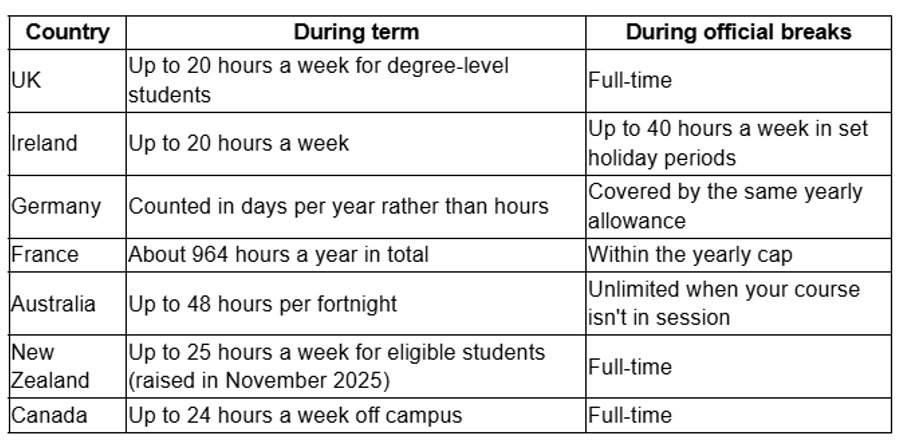
A few notes on these.
Germany counts days instead of hours. Recent sources describe an allowance of 140 full days or 280 half days a year, while older articles say 120 full days or 240 half days, so confirm the current figure with the German authorities.
Australia counts by the fortnight, not the week. Working 30 hours one week and 18 the next can be fine, but working 25 hours in each week would break the 48-hour limit. Some research students are treated differently, and course placements that are a required part of your studies may not count toward the limit.
New Zealand increased its limit from 20 to 25 hours a week in November 2025, so older articles may be out of date.
The UK limit applies to degree-level students and is counted by week. Self-employment and freelancing aren't normally allowed, and unpaid work can count toward your hours.
Key Rules Students Often Miss
You usually can't work before your course starts. In several countries, work rights only begin once your course has started.
The limit on your visa is what counts. Check the conditions on your own visa or eVisa. Don't rely on a friend's experience or a general blog post.
Different students have different rules. Your level of study, the length of your course and whether your course is on or off campus can change the limit.
On-campus and off-campus work can be treated differently. Some countries have separate rules for jobs within your university.
Placements and internships may count. In some systems, work placements are treated differently from ordinary jobs, so ask your university.
Cash-in-hand work is risky. Working without proper records or tax arrangements can cause serious problems for your visa.
Freelancing and running a business may not be allowed. Some student visas ban self-employment.
What Happens If You Break the Rules?
Working more hours than your visa allows can lead to serious consequences. These can include a visa being cancelled, difficulty with future visa applications and trouble with immigration records. The penalties vary by country, but they're serious everywhere. It isn't worth risking your degree and your ability to stay for a few extra shifts.
If you're ever unsure whether a job is allowed, ask your university's international student office before you accept it. Our guide to common student visa rejection reasons also explains why honesty and clear records matter.
What Kinds of Jobs Do Students Usually Find?
Typical student jobs include:
- On-campus work: library assistant, student ambassador, research assistant, teaching or lab support, campus café or events
- Retail and hospitality: shops, restaurants, cafés and bars (note that some countries have extra rules about certain jobs)
- Delivery and warehouse work: where permitted under your visa
- Tutoring or language support: where allowed under your visa
- Admin and customer service: office help, call centres or reception
Pay and availability depend on the country, the city and the time of year. Some countries set a minimum wage, which helps protect students, so know what's normal where you're studying.
Where to Look, and What to Avoid
Good places to start: your university's careers or student jobs service, official job boards, and campus notices. Many universities have dedicated student job portals.
Be careful with scams. Avoid job offers that ask you to pay a fee, send money, share bank details early or work for a company you can't verify. Be suspicious of offers that seem unusually generous. A genuine employer won't ask you to pay to be hired.
Keep your documents in order. Employers will usually ask to check your right to work. Know how to show your visa status in your country.
Money Basics: Tax, Records and Pay
Most countries require you to have some form of tax or identification number to work legally, and you may need to declare your earnings. Keep your payslips and records, make sure you're paid at least the legal minimum wage, and learn what tax applies to you. Rules vary, so ask your university or the official tax authority if you're unsure.
How Much Should You Expect to Earn?
It varies hugely by country, city and job. A useful way to think about it is to take your likely hourly pay, multiply by the hours you're allowed, subtract tax, and then compare with your actual living costs. Don't count on a fixed figure from a blog post. A part-time job often covers part of your food and transport, and that's a reasonable expectation.
Balancing Work and Study
Your degree is the main reason you're abroad. A few simple habits help.
Start your studies first. Settle into your course before taking on regular shifts.
Choose flexible hours. Avoid shifts that clash with classes, placements or exam periods.
Don't work the maximum every week. The limit is a ceiling, not a target.
Watch your grades and energy. If your studies slip, scale back.
Make time to rest and meet people. Burning out helps nobody.
Our guide to your first 30 days abroad gives you a simple plan for settling in before you start looking for work.
Check Before You Apply to a Course
Since you should understand the rules before applying, here's a short checklist.
- Does the country allow students to work part-time on your visa type?
- What's the hour limit for your level of study?
- Do any rules differ for your specific course, such as a nursing or placement-based degree?
- Can you cover your costs even if you can't find work for a while?
- Do you know the cost of living in your city?
If the answer to the last two is "no," think carefully about your budget before committing.
Common Mistakes to Avoid
- Treating part-time work as your funding plan. It's a bonus, not a foundation.
- Working over the limit. It can put your visa at risk.
- Relying on old information. Limits have changed in several countries recently.
- Accepting cash-in-hand work. It can create legal problems.
- Falling for job scams. Never pay to get a job.
- Letting work hurt your studies. Your degree comes first.
- Not checking your own visa conditions. They're what count.
Need More Than the Basics? Talk to Cliftons Study Abroad
This guide covers only the basics. Work rules depend on the country, your visa and your course, and they change often. Which country's rules suit your plans, how to plan your budget realistically and what to check before you apply are all things a counsellor can help with.
At Cliftons Study Abroad in Kochi, we help students across Kerala compare countries, shortlist courses and universities, and manage applications and visas. If you'd like personal guidance, our counsellors are ready to help.
Wondering how part-time work fits into your study plans? [Contact Cliftons Study Abroad today for a free consultation.]