
Ask ten people which UK university is "the best" and you'll probably get ten different answers. That's because the best university depends on what you want to study, what you can afford, and what you want to do afterwards. A famous name on a certificate doesn't help much if the course doesn't fit you, or if the fees put your family under pressure.
Still, rankings are a useful place to start, and the new 2027 editions are out. This guide covers the basics: which UK universities rank highest, what those rankings actually tell you, and how to choose sensibly. It's written for students and parents in Kerala who are just starting their research. If you'd like advice for your own situation, Cliftons Study Abroad is happy to help.
How the Rankings Work (and Why They Disagree)
Three global rankings come up most often: the QS World University Rankings, the Times Higher Education (THE) World University Rankings, and the Academic Ranking of World Universities (ARWU, sometimes called the Shanghai ranking). Each one measures slightly different things. QS leans heavily on surveys of academics and employers, while others weigh research output and citations more.
That's why the same university can sit at different places in different lists. Oxford is first in the THE 2027 ranking but fourth in QS 2027, for example. Neither is "wrong". They simply look at different things. The sensible approach is to treat rankings as a rough guide to overall reputation, not as the final answer.
There are also UK-specific league tables, such as the Complete University Guide, the Guardian and the Times and Sunday Times guides, which focus more on teaching quality and student outcomes. These sometimes give quite different results from the global lists.
The Top UK Universities in the 2027 Rankings
Here's how the highest-ranked UK universities look in the two most-quoted global rankings for 2027.
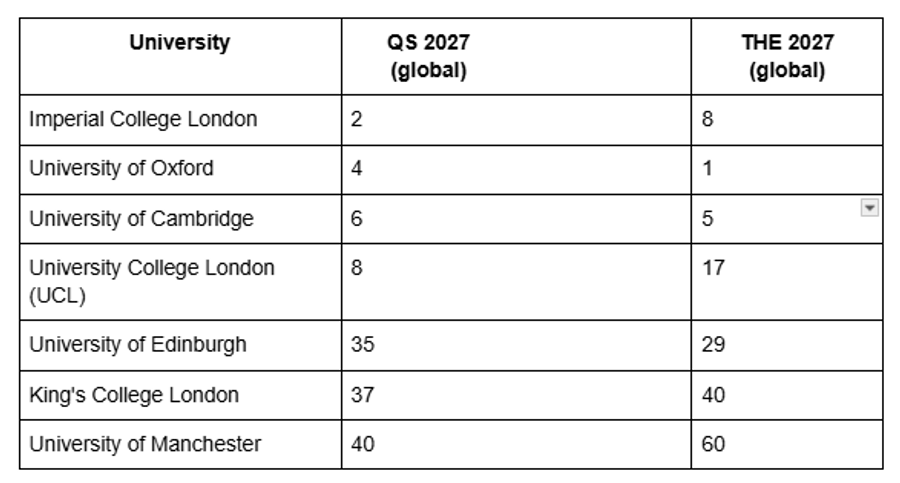
Beyond these, the QS 2027 list also places the University of Bristol (57), the London School of Economics (62) and the University of Warwick (68) in the global top 70. Altogether, more than a dozen UK universities sit in the QS top 100, so the UK is well represented at the top of world higher education. Exact positions can shift slightly depending on the source, and a few spots are shared ties, so check the official ranking sites when you need a precise figure.
A Quick Look at the Big Names
You don't need to memorise league tables. It helps to know what each well-known university is generally famous for.
Imperial College London is focused on science, engineering, medicine and business, and it's a favourite with students who want a technical career.
University of Oxford and University of Cambridge are the two oldest and most famous, with strong reputations across almost every subject. They're also among the hardest to get into, and entry usually involves very high academic expectations and, for many courses, interviews or extra tests.
UCL (University College London) is a large, wide-ranging London university with strengths in many fields, from engineering and architecture to social sciences.
University of Edinburgh is Scotland's most internationally prominent university, strong across arts, sciences, informatics and medicine.
King's College London is well known for health, law, humanities and international relations.
University of Manchester is a large university with a good reputation in engineering, business and sciences, and living costs outside London are usually friendlier.
London School of Economics (LSE) specialises in social sciences, including economics, finance, law and politics.
Warwick and Bristol are both respected for business, economics, engineering and sciences, and both turn up near the top of many UK league tables.
Strong Universities That Don't Always Make the Headlines
Here's something many students miss. The UK has well over a hundred universities, and many outside the very top of the global lists are excellent, especially for specific courses. Universities such as Glasgow, Durham, St Andrews, Birmingham, Leeds, Sheffield and Southampton, among others, have strong reputations in particular subjects and are popular with international students.
There are also universities known for being practical and career-focused, with good industry links and placement options. For some students, especially those aiming at a specific profession, one of these can be a better fit than a more famous name. The best way to find out is to look at the specific course, not just the university.
Why the Course Matters More Than the Ranking
A university's overall ranking is an average across hundreds of subjects. A university ranked 40th overall may be among the best in the world for the exact subject you want, while a higher-ranked university might be ordinary in it. So before you commit, check the subject-level rankings and the course details.
A few things worth looking at for any course: what you'll actually study, how much practical or placement experience is included, how many students find work or further study after graduating, and whether the course is accredited if your career needs it (engineering, nursing, pharmacy and law, for example, can have professional requirements).
If you're thinking about a particular field, we have separate guides on subjects like business management, cybersecurity, nursing, pharmacy and physiotherapy in the UK.
Don't Forget Location and Cost
London is exciting, but it's also expensive. Rent and daily costs are noticeably higher than in cities such as Manchester, Glasgow, Edinburgh, Leeds or Sheffield. For many families in Kerala, studying outside London can ease the budget without giving up on quality. Tuition fees also vary a lot between universities and courses, and they usually rise from year to year, so always check the current figure on each university's own website for your intake.
If you're planning to fund your studies with a loan, our basics guide to education loans for studying abroad is a helpful place to start.
Getting In: What Indian Students Usually Need
Requirements differ by university and course, but a few things are fairly standard.
For undergraduate study, you'll generally need your Class 12 results, with the required marks depending on the course and university. Highly ranked universities and competitive courses ask for much higher results. For postgraduate study, you'll need a recognised bachelor's degree with minimum marks set by the university.
You'll also need to prove your English, most commonly with IELTS, though other tests are accepted. The score required depends on the course, and some, like healthcare programmes, ask for more. Alongside that, expect a personal statement, references, and sometimes interviews, entrance tests or portfolios.
Highly ranked universities are competitive, so applying to a mix of "ambitious" and "realistic" choices is usually smarter than putting everything on one famous name.
Visa and Staying On After 2027
If you're planning to start in 2027, one change is worth knowing about. The UK's Graduate Route visa, which lets eligible graduates stay and work after their studies, is being shortened from two years to 18 months for applications made from 1 January 2027. So students beginning their courses in 2027 should plan on the shorter period. Immigration rules also change fairly often, so check the official UK government website for the latest details before you finalise your plans.
Common Mistakes to Avoid
- Choosing by name alone. A famous university isn't automatically the right one for your course.
- Ignoring subject rankings. Overall rankings can hide big differences between subjects.
- Forgetting about cost. Look at tuition, rent and daily expenses together, not just the fee.
- Applying only to the top few. Competitive universities reject many strong applicants.
- Leaving it too late. Applications, offers and visa steps all take time, so start early.
- Relying on old information. Rankings, fees and visa rules change every year.
Need More Than the Basics? Talk to Cliftons Study Abroad
This guide only gives you the basics. Choosing the right university means matching your marks, budget, course and career goals, and that's where personal advice makes the biggest difference. Which universities are realistic for your profile, how competitive your chosen course is, what scholarships might be available, and how to time your application are all things a counsellor can help with.
At Cliftons Study Abroad in Kochi, we help students across Kerala shortlist universities, prepare applications and manage visas for the UK and other destinations. If you'd like personal guidance, our counsellors are ready to help.
Not sure which UK university is right for you? [Contact Cliftons Study Abroad today for a free consultation.]